Thursday, 27 June 2013

Revealed

I struggled with the choice of colour for my 911 project for a long time. 

Of course, it would have been simple (and probably financially optimal) to return it to its original colour (silver) but firstly the car is already a long way from being standard (bodywork, interior, engine), and secondly I don't think the world needs another silver Porsche. 

The main stipulation I set myself was that the colour would have to be period correct. Thankfully, Porsche's palate from the early 1970's was nothing like as limiting as the variations on grey, silver, black and white of the current range, so I had a nice wide choice. 

I ruled out the white/creams on the basis that I wasn't trying to build a RS rep. Black was out for reasons of practicality, and the metallics I excluded on grounds of their additional cost and the problems of future matching.  Some of the brighter colours like viper green and blood orange have had quite a lot of exposure recently - I didn't want to follow a trend that might possibly date. Similarly, I ruled out pale yellow as a mate has an original RS in that colour, and the reds are just a little too mid-life crisis. I'm also quite happy to admit I bottled some of the errrrr... braver colours like aubergine (which can look brown in some lights) chartreuse (limey green) fraise (pink) and the browns.

Looking around the cars at Essen it was noticeable that cars painted in the more pastel colours appear to have less aggressive down the road graphics that the brighter shades, something that is become more and more important as we move into an anti-car age. In its current yellow/black form the reaction from other road users is somewhat polarised, I can see hackles rise amongst some - and the planned exhaust system probably wouldn't help.

What eventually swung it was a plain 911T I saw in one of the outside courtyards in Germay, it was in a lovely period colour, one with classic Porsche resonances, worked well with the 911's curves, and even when combined with some well chosen accents couldn't been seen as aggressive.

I briefed Charlie the Paint on my return. 

A few weeks later the car re-appeared on my drive-way:

Porsche Gulf blue
 SS7


Wednesday, 12 June 2013

911T Project - Update

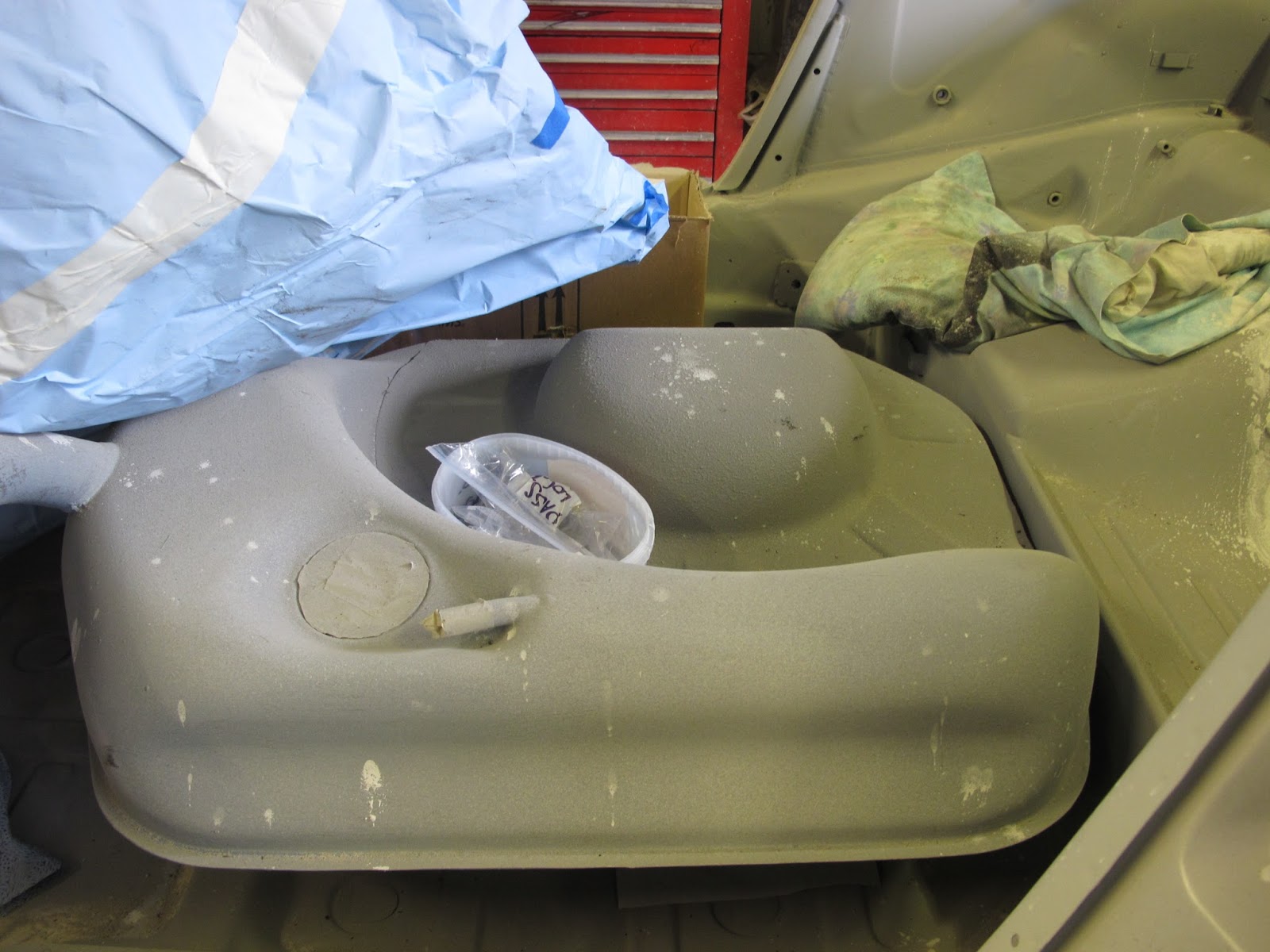
I'd mentioned that the 911 had been sent along to the blasters to have the old paint cleaned off. Well it's back and in the paintshop. 

Here's where we've got to:

Blast cleaned and coated

Re-profiling the rear arches


Smoothed and ready for paint

The other side (and shy paint genius)

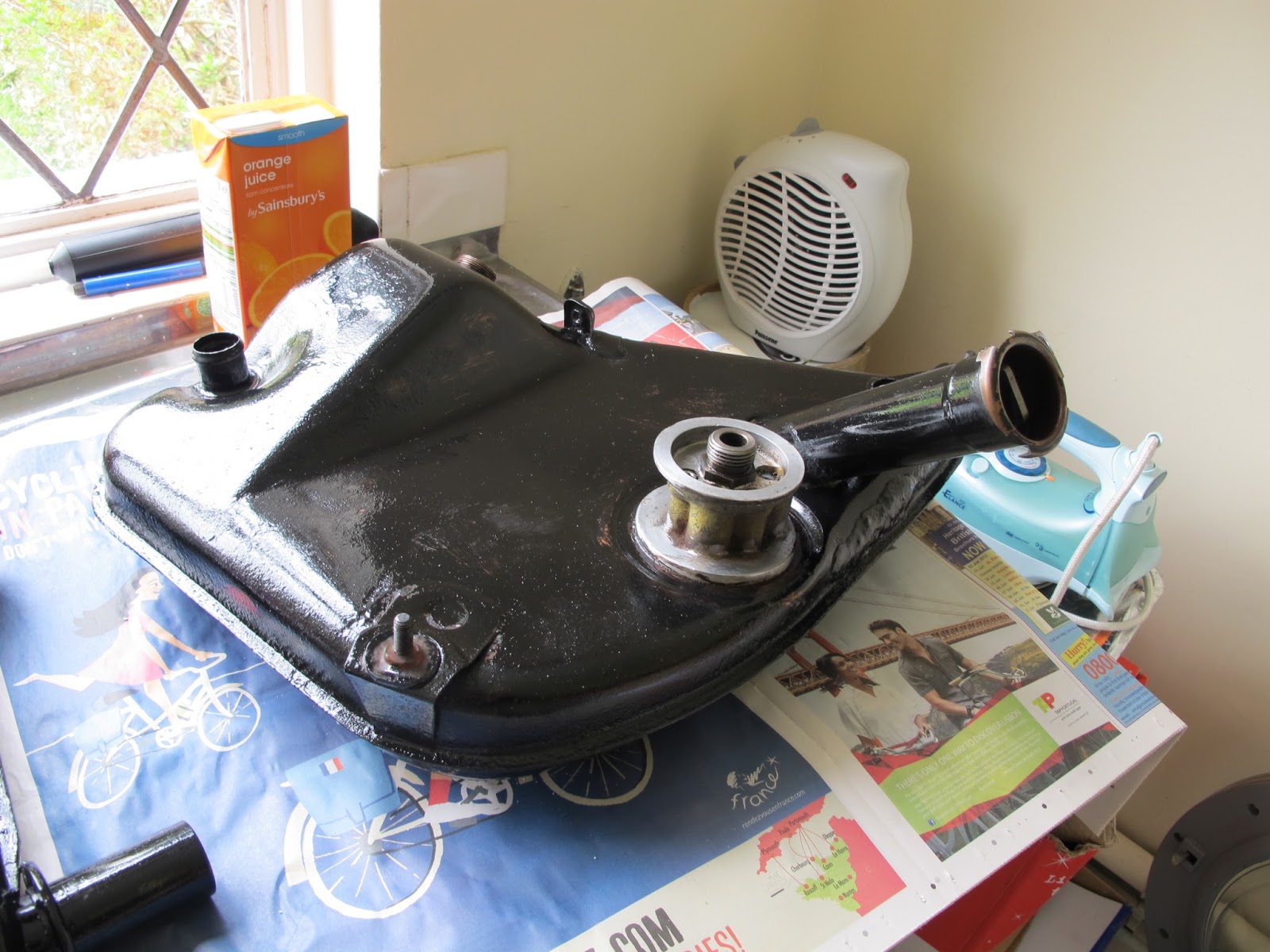
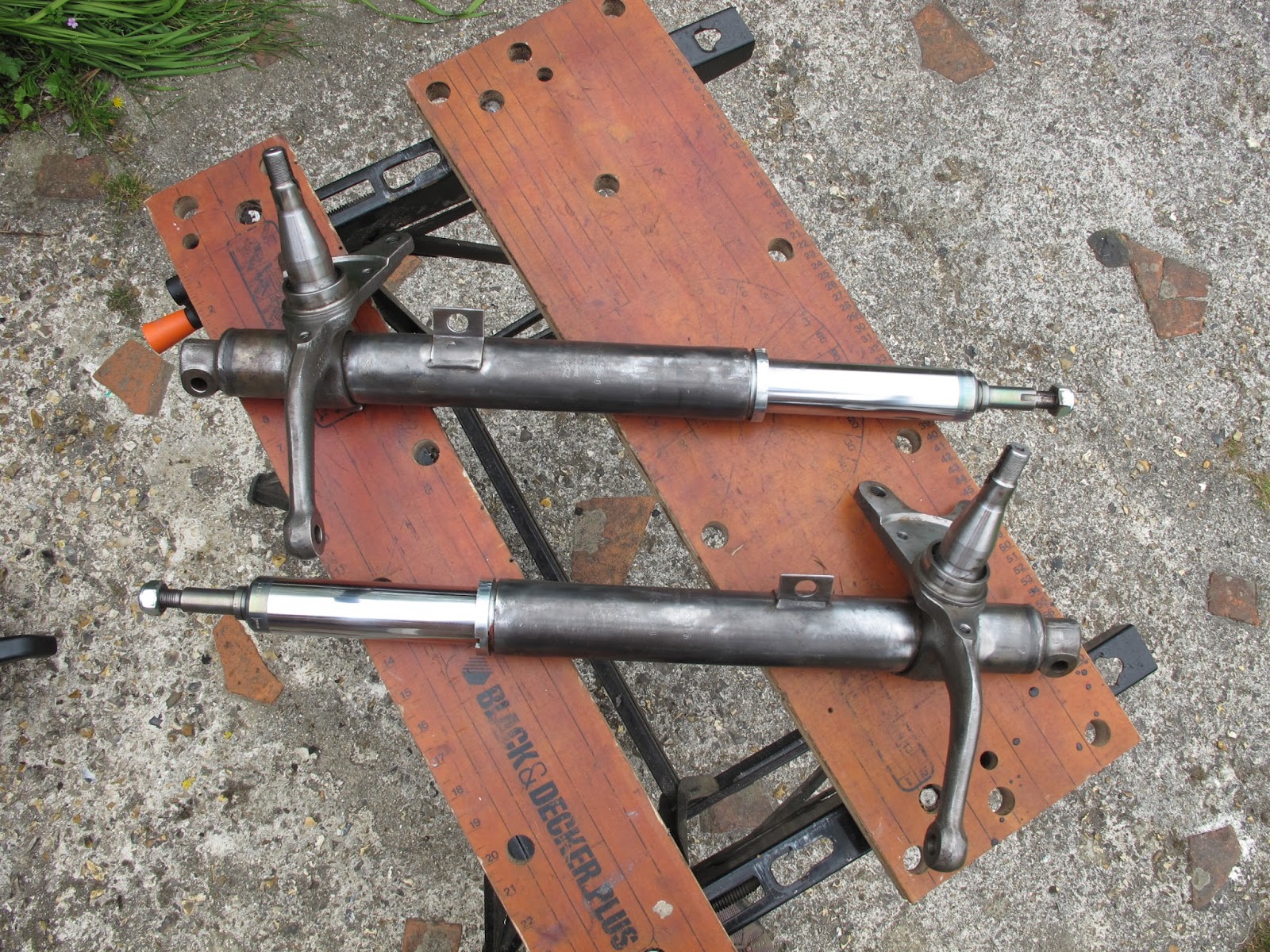
Meanwhile I've been busy at home:


Hot air gun to remove the underseal

Wirebrushing the tank clean
After two coats of POR15, a sealant and a
good plastering with stone chip 
Clean front wishbones

Clean rear trailing arm......
......painted

Oil tank - its copper coated steel

Oil tank after a first coat of POR15

Front struts cleaned


Front struts painted in a jolly green,
approximating the Bilstein originals

Assorted bits blast cleaned....

....assorted bits painted

More assorted bits after paint.

Toodle pip,

SS7

Essen 2013

A few weeks ago a DDK mate called me to ask if I fancied a road trip. He and a friend were planning to drive over for the big classic car show in Essen and had a spare seat. Did I fancy it? 

I thought long and hard for 1/10th second and said "Yes".  Not only was I going to be at a loose end for a few days, but I was also in the middle of trying to decide on a colour for my 911T project. After all, where else could I almost guarantee to see old Porsches in every available colour than at Germany's biggest classic car show in the 911's 50th anniversary year?

Techno Classica Essen (to give the show its full name) is certainly the most important, if not the biggest classic car show in Europe. Its been going for 25 years, and around 200,000 old car nuts turn up for each one. In contrast to the UK's strictly amateur hour event at the NEC, Techno Classica enjoys major support from the home manufacturers - not only a recognition of the importance the Germans place on their heritage, but also a reflection that for a long time the centre of gravity of the European motor industry has lain just to the west of River Elbe.
BMW Motorrad celebrates the ditch pump

We travelled up on Thursday afternoon, took the Eurotunnel (who else remembers how far away France was before they dug that?), and overnighted in a Belgian hotel before completeing the drive to Essen the next morning. It would have been completely painless had we not spent a lot of time driving around the exhibition centre trying to park before throwing in the towel and ending up at the Park & Ride, a full autobahn junction away.

It really is big. There were four massive exhibition spaces, and a whole series of smaller halls, corridors, nook, crannies, basements, mezzanines and courtyards. Every taste in old cars is catered for, from Pebble Beach grade Bugattis with a price tag that would fund a BBC pension to tatty 'Youngtimers' at  money you could almost afford. 

Steve McQueen's 911S; $1.4m to buy and
then restored to within an inch of its life. 
I say 'almost', but you would have to be very, very keen or a recent Lotto winner to buy anything at Essen. A mass hysteria overtakes vendors, and everything is marked up to an incomprehensible level.  I took lot of pictures but bought hardly anything other than a sustaining Wurst mit Bier (or two). Shame, really. I hadn't travelled equipped with a shopping list, but the very least I'd hoped to find was a 1/43rd scale model 911 in my chosen colour.

Germany and great automotive art, going together
 like pizza and pineapple  for 25 years
Eye-watering prices aside, everything automotive related was available at Essen, from dodgy art to rare parts, including any sort of clothing and memorabilia. All of the top flight European dealers take space, plenty of UK based firms come over too, along with a huge range of restoration specialists. It really does take a couple of days to see it all. 


How would Sir like his hotrod?
Later on we booked into our colourful and reasonably priced hotel on the other side of town, and spent the evening in a pizza restaurant where we enjoyed dinner and the sort of conversations that would provoke sighs of sad incomprehension in mixed company. Next day, eschewing the joys of parking miles from the halls, we used the inevitably clean, cheap and punctual public transport system and spent a second day at the show.

The signs of domination by the three big German car combines were subtle but easily seen. As a Brit proud of our industrial heritage, it was heart breaking to see Monte Carlo winning Minis celebrated in the BMW hall, and a 1926 Le Mans team Bentley sitting proudly in the middle of the VAG display areas - along with vintage Bugatti's and (whisper it) Porsche's classic arm. 
Porsche's stand in the VAG hall; not rammed with
jewels from their museum.


More VAG heritage, a 1926 Le Mans
team Bentley
Funnily enough, although I expected to see the choicest selections from Zuffenhausen's museum at Essen, the company thought fit to bring only a few cars, one of which was a 2013 vintage 991. 

Now there's an idea.....
But it wasn't a worry, old 911s of all varieties (and colours) were present in abundance, so I had plenty of opportunity to choose the ones I liked.

The third of Germany's automotive Goliaths, Mercedes Benz, had a hall the size of a First Class Cricket ground all to themselves, and laid on an incredible display fitting for the company that invented the car.


VW making a splash of the
7th generation GTi

Two full days were enough; after having covered endless miles on foot, rummaged through countless stalls, stared at priceless classics, gawped at lunatic prices, and pretty much decided what colour 911 I wanted it was time to head back to the UK.
The DS, amazing motorshow crowds for 63 years
Alfa booked a corner to display their
 stunning Tipo 33s
After a civilised breakfast on Sunday, we loaded up the lumpen riding (but abstemious) SportLine Audi A6 and returned along Belgium's poorly maintained autoroutes to Blighty. 

One of the Audi's occupants leavens his patrician Porsche habit with a rootsy enthusiasm for old Dagenham dustbins, so we stopped in a scruffy field off the M23 where a 'Classic Ford Car show' was taking place. 

The shaven headed, heavily tattooed Ford enthusiasts with their modified Escorts (baseball bat not quite hidden behind the front seats) and Sierras couldn't have been a bigger contrast to their fellows over the channel, and the vendors sitting behind trestle tables proudly displaying rusty, oily and unidentifiable components were a long way from the slick dealers at Essen ("Original works 917 steering wheel? Certainly sir, we have one in stock, a snip at 14,000 Euros").  

It was ironic then that those Kentish traders proved to be a happy hunting ground for valuable Porsche bits at below market prices. We left clutching a set of 356 horns, a rare 911 Sportomatic gear knob ("Any idea what its off guv? No? How about a fiver then?") and a 1/43rd model of a 911 in just the right colour.


Excellent trip.

SS7


Wednesday, 29 May 2013

A Little Width on the Hips

The Romans knew a thing or two about roads. They built over 50,000 miles of high quality stone-surfaced roads across their empire, enabling the rapid movement of their armies, and allowing trade and commerce to link distant outposts. 

We have one in our neck of the woods; Stane Street. It's 56 miles long, and links Chichester (or Noviomagus Reginorum as the Romans snappily called it) to London Bridge in more or less a straight line. In fact, like many of the Roman Roads in Britain, much of the route is still used as a road, bar a section over the downs near Halnaker where walkers can still tread the original 2,000 year old stones poking through the grass.

Being of a pragmatic mindset, the Romans standardised the width of their roads around the need to allow a couple of carts or companies of soldiers to pass by one another without interference, and decided that 24 feet (in the context I make no apologies for going all Imperial on you) was a sensible dimension.
Stane Street on the South Downs

Oddly (or not), 2,000 years later, the UK Highways Agency's standard width for a two lane road is still 24 feet. This is for the same millennia old reason; two horses side by side are about 5ft wide, as is a cart or carriage roomy enough to carry two seated adults between it's wheels, so to allow them to comfortably pass each other, a road width of eight yards is required.

When motorcars replaced horses and carts, not much changed. Karl Benz's Patent Motorwagon from 1886 was a couple of inches under 5ft wide, and by 1959 Ford's 100E Popular family saloon still measured only 5ft 1inch across.  The original Porsche 911 spread a little; 5ft 3inches, while Jaguar's seminal E Type was 2inches wider. Just the 2 inches mind you.

These thoughts occurred to me when I saw photograph of Jaguar's new F type next to its 1961 predecessor; the F type is a girdle busting 6ft 4 inches across it's arse, nearly a foot wider than the E. 
One is designed for Stane Street, one for I95....

In its latest incarnation the svelte 911 has expanded to 6ft 3inches in 991 C4 form, and the Ford Popular's successor as family transport, the Focus, has grown 13inches to 6ft 2inches.

We're all supposed to be getting fatter, so its not really surprising cars are. But at least in a UK with a roads infrastructure based on a 2,000 year old EU standard, its not surprising that there's just not the room to have fun that there used to be.

SS7


Friday, 17 May 2013

Gearbox latest

I few weeks ago I took my gearbox to Jez at Carrera Performance. I knew synchromesh on 3rd gear was very tired, and his brief was to open the unit up, and let me know what was needed for a rebuild. I've been on tenderhooks ever since; bits for these units can be very expensive, and severe wear can render the casing scrap. 

So it was relief I learned this week that the gearbox internals were in good condition, and all it need was a few synchromesh rings - in fact about the least I could have hoped to get away with. It should be back with me in a couple of weeks. 

An aside I was interested to hear a comment Jez made when we were inspecting the 'box, comparing the weight favourably to the later G50 units. From what I'm able to tell, the various weights as follows;

  • G50 gearbox used in the later Carrera 3.2s                                                        ~70kg
  • 915 gearbox with aluminium cases used in the SCs and first 3.2s                ~58kgs
  • 915 gearbox with magnesium cases used in the '72 and '73 911s                ~50kgs
The stronger aluminium cases were adopted when Porsche started to worry about the torque of the bigger engines, but from what I can tell from other owner's experiences, with sympathetic use the mag  alloy cases do just fine. Certainly losing 20-odd kilograms from the tail of the car can only be a good thing.

SS7


Blast

I removed the final few bits and pieces from the car and it was ready for cleaning. The yellow paint coating the car appeared to be a single stage acrylic that was either applied by an amateur, or a dealer looking to give the car a cheap once over for a sale. 

In any case it was a poor job; there's overspray everywhere and preparation around the door shuts etc was woeful. If I was ever to achieve a decent end result it all needed to come off 

Mechanical methods are too time consuming and really only used where the bodywork is very fragile or extremely precious. I was left with a straight choice; blast cleaning or dipping. The latter involves dropping the shell into a foul caustic concoction that will remove anything that isn't metal; underseal, seam sealer, rust, paint all disappears leaving clean, fresh metal behind inside and out. The shell is then rinsed, and once any repairs are completed. is dipped again in a rust proofing base coat. 

Im sure there are companies out there doing this very well, the problems arise when the capillary action takes the acid up into seams and between panels deep in the structure of the car. There it lurks, and often doesn't reappear until much, much later when your freshly restored car starts weeping rust from the seams.

Blasting on the other hand also has disadvantages. Obviously it won't touch the inside of any box sections, and a heat generated by heavy handed operator can distort panels, easily wrecking a shell. The media - generally a dry, fine sand - gets everywhere too. 


In the end I decided to use a blast cleaner recommended by a DDK mate; De-Corrosion Services in Chertsey, West London.  They've done a couple of old 911s - in fact they'd already cleaned the panels I'd taken off the car earlier. Their offer to collect and deliver the shell sealed it - finding someone to move wheel-less old cars isn't easy. So one sunny day in April the shell on its dolly was strapped onto a trailer and taken away. 

It would very different the next time I saw it.


SS7


Monday, 13 May 2013

911 Project Update

Well the telecom companies have finally managed successfully to install broadband into the new abode. Much like hangovers, the pain and nervous exhaustion brought on by every house move is enough to make me swear never to do it again. I didn't make things any easier this time by dismantling the old Porsche before moving it from garage to garage. Not only are a dozen crates full of components littering the house, but body panels decorate almost every room. And the only option for moving the 'car' - in reality a bare rolling chassis - was for me to push it down the road while one of the younger SS7s sat on a wooden box and steered. The proximity of the 'new' house to the old one - 400m at most - was a definite bonus. As I write, 200kgs of 911 engine still sits on the floor of the old garage. 

The actual project - removing only the glass and parts essential for new paint, and refreshing the mechanicals - has progressed to a full blow restoration. My reluctance to take the final step of stripping the car of its wiring loom, braking system and all of the running gear wilted in the face of determined opposition from the DDK crew. 

Here's a picture of the car. Its on the driveway sitting on a dolly ready for the next stage of the project.


More next time.


SS7