Wednesday, 15 September 2010

I = V/R*


I wonder why General Motor's US version of their electric + range extended car is called the Volt, while GM Europe's version is called the Ampera?

Is it because US citizens don't know what an Ampere is? But I don't really think a high proportion of us Europeans do either, so why not 'Volt' across the globe?

SS7
* Ohm's law

Monday, 23 August 2010

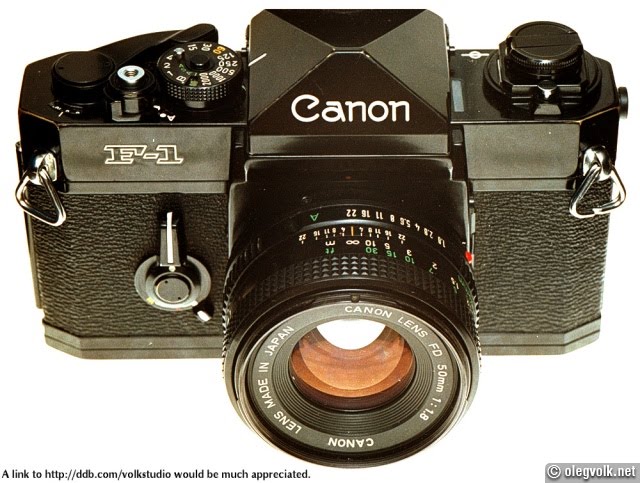
Canon F1


I've been using digital cameras for a few years now. They're so simple to use, and the ability to see the results instantly, and stick them on the PC/web etc. make them perfect for a casual snapper like me. Its no wonder that 35mm camera's are now like LP's; an almost forgotten technology with a dwindling (but vocal) band of users.

However, the other weekend I was at the Vintage at Goodwood festival, and to mark the occasion I dug out my old Canon F1 SLR from the bottom of its particular hiding place. After a bit of searching in my local High Street I even found a roll of 400asa film to use. The old Canon was one of the last all metal camera bodies - the brass is beginning to show through in places, and it weighs a ton (well, 1.45kg with its Tamron zoom lens).

Even the simple act of loading the film gave pleasure, the mechanical feel of the buttons to open the back, the precision of the film speed setting, the lovely 'double-click' as the mirror moved and the shutter worked, the soft click of the aperture ring on the lens, and seeing the settings change through the viewfinder as I decided on shutter and aperture settings. I even got a kick of carrying its reassuring weight around in the crook of my arm - straps are soooooo not on!

In fact, there was as much pleasure in using the machine as in any results I was going to get; it was like a mechanical watch. You just know its not as accurate as the quartz one, yet its somehow so much more satisfying to own.

I must do it more often.

SS7

Thursday, 19 August 2010

TE Lawrence


My middle name is Lawrence*. Perhaps that's why I've always been fascinated by the story of Thomas Edward Lawrence. Born on the wrong side of the blanket, he was neurotic long before it became a recognised state of mind. In his years at Oxford studying classics, he would force himself on long cross country night marches, or fast for days, denying himself even water. In the long holidays he traveled across on foot across France and then the Middle East, studying the Crusader castles . Lawrence also worked on archaeological digs in modern day Iraq, where he learned Arabic dialects, the history and cultures of the region. As a sideline he worked for British Intelligence mapping those areas of semi-desert.

So in many ways his whole life had been to prepare him for his role in the Arabs' revolt against the Ottoman empire, when the red-top press of the day created the 'Lawrence of Arabia' myth.

Lawrence's curse was the realpolitik of the day. He'd been allowed to promise the Arabs a homeland and Arab state in return for their support of Allenby's army. Alas, under French pressure a deal had already done, the allies parcelling up the middle east into various client states.

One of the extraordinary things about stories of Lawrence's life is how the names continue to echo through history: Beirut, Damascus, Iraq, Baghdad and Aquaba.

Lawrence didn't have a good peace. The betrayal of the Arab cause effected him deeply, and he tried lose his hated 'Lawrence of Arabia' identify by re-inlisting in first the Army and then the RAF under pseudonyms. It was under the name 'Shaw' that he published his masterpiece Seven Pillars of Wisdom, which related his story of the Arab revolt.

Lawrence tried to escape his troubles by riding fast bikes, and bought a series of Brough Superiors, the superbike of their day. He would use them for long, fast rides through the night, achieving average speeds that are impressive even by modern standards.

His life ended in May 1935, at the age of 46, when he crashed his bike avoiding a couple of bicycle riding youngsters in a local road. He died of the head injuries suffered in the accident - incidentally one of the surgeons involved in his treatment went on to produce the research that led to the first effective helmets.

Lawrence is buried in a quiet Dorset cemetery on the edge of the small village of Moreton. The other day I was passing on the way home from holiday in the area and visited his grave.

SS7
*Its a family name, no relation

Who uses more than 100bhp?


My old fashioned, aircooled, ditch pump engined BMW GS is the Volvo estate of the bike world. It does about 130mph, and has 6 nicely spread gears. Just occasionally I will use wide open throttle and getting on for peak power revs (around 7000rpm) where the full 100 or so horsepower is available, and I can do that in 2nd, 3rd, and 4th gear without hitting licence-losing speeds.

In car terms this Volvo-bike is not slow - its capable of 0-60mph in around 4 seconds (not with me riding it isn't...) so is quicker than pretty much everything on 4 wheels I'm likely to encounter.

You may be surprised to hear that the latest, baddest, fastest superbike is also made by BMW. The S1000RR produces an astounding 190bhp and does over 180mph. To help prevent it killing riders unused to controlling MotoGP levels of performance, it has a full set of electronic safety aids; including state of the art traction control, selectable power maps and ABS.

But I was thinking about that 190bhp. Typically for a modern superbike, the S1000 is geared for over 100mph at the red-line in 1st gear. To access full power, you will need to have the throttle on the stop, and the engine spinning at 13,000rpm. In rough terms that's going to be in the area of 120mph, 135mph, 150mph, 165mph in 2nd, 3rd 4th and 5th gears.

Even leaving the question of legality, even on the open A roads in my part of West Sussex, its difficult to see those sorts of speeds being a practical proposition, certainly not for the sane or sensible.

I wonder how many of those S1000 riders ever really see the 190bhp they've paid for?

Friday, 30 July 2010

T25 News


There’s been some more in the press recently on Gordon Murray’s T25 project. We’ve now moved from an engineering hack to pre-production prototypes (‘XP’ in McLaren parlance) and pictures of a very finished looking car. So far, so good, its supposed to be cheap to build, brilliantly packaged (for a Mum or Dad of two, a 1+2 layout is perfect) and crucially, good to drive - in spite of the diminutive 700cc motor.

Yet, I’m sure I’m not alone in finding this all terribly frustrating. While Murray has talked to many organisations about putting the project into production, along with its iStream low cost production system, there hasn’t been any news of any contracts signed.

And until then, there’s no chance the T25 will be built, maddening for everyone who would head to a dealer with their deposit tomorrow.

Hubris Repeated

It only took their first opportunity for a 1-2 in two seasons for Ferrari to put themselves in the mire.

Repeating the actions of Austria in 2002, they ordered the drivers to reverse their positions to give the favoured son the benefit of the extra points for first place, and the manoeuvre was carried out in a blatant fashion by the drivers. Ironically (or not) it was 2002’s actions in Austria, and the resultant furore, that caused the FIA to introduce the ‘no team orders’ rule in the first place.


Then, as in Hockenheim, they faced booing from the crowd, an embarrassing podium ceremony and critical questioning from the specialist press corps. Then, as now, the team management shrugged their shoulders, accused their many critics of not understanding motor racing, and pretended it was all part of anti-Ferrari bias in the ‘Anglo’ press.

Then, as now, we were faced with the unedifying site (and sound) of senior engineers’ and drivers’ bare-faced lies about missed gear changes and being all the drivers’ decisions - even though the telemetry shown on screen clearly showed Massa using only 50% throttle leaving the corner where the ‘pass’ took place.

What it did demonstrate once again, quite clearly, is that Ferrari feel they have no loyalty to any concept of ‘sport’ in Formula One, or to its many supporters, or those that turn up each fortnight having paid their hundreds of Euros or Dollars to see a race.

For them, Ferrari is bigger than F1, and what’s good for the team is good for the rest. That's the way the planets should be aligned, and the Scuderia can get on with winning in order to maintain the ‘brand’ that allows them to make money from the road car and T shirt business.

We saw that in during the triumphalism of the Schumacher years, at Indianapolis in 2005, in Austria in 2002, and in their shabby behaviour during Stepneygate. So perhaps we shouldn’t be surprised to see it again in 2010.


Talk about team orders long being a part of Grand Prix racing (so was sudden death on Sunday afternoon), and being implemented by other teams (none with the flagrant arrogance of the Scuderia) show a point being missed.

What F1 shares with other great sports is that it really isn’t just about winning, it about winning well.

It’s a shame that Ferrari’s hubris blinds them to this.

Billy Fiske: King of Speed.

I took SS7 jnr and the F-in-L to the theatre last weekend. We went to see a new play by David Morris based on the life of Billy Fiske, who was killed at nearby Tangmere in the Battle of Britain. Two things made Fiske remarkable; his nationality – he was the first US citizen to volunteer for the RAF – and he was a truly gilded youth.

From a privileged background, he won two gold medals at Winter Olympics, drove a Supercharged 'WO' Bentley, set a time for the Cresta run that lasted decades, and wooed and won the wife of a British aristocrat. Not only that, he had the sheer front to be a thoroughly lovely bloke; modest, thoughtful, considerate, and with a standard of personal integrity many of the period could have benefitted from; in 1936 aged only 24 he refused to defend his title at the Berlin Olympics in 1936 in protest at the regime.

The play was a good effort, performed in front of a sadly ½ empty play house in Bognor, and fairly captured the humanity of the man and the strange existence the pilots led, facing death on every sortie, yet returning each day to a life of comfort and desperate fun. There was some anachronistic language (did 1940 RAF pilots really need to “focus” on shooting down the enemy?), but I enjoyed the evening.

There’s talk of a transfer to London and I wish the production well, but I did find myself wondering if it wouldn't make a great movie.

Billy asked to be buried near Tangmere in Boxgrove Priory. I’ve visited the well-tended grave in a quiet corner of a beautiful part of West Sussex , between the South Downs and the English Channel.