Showing posts with label Porsche 911T. Show all posts

Tuesday, 13 November 2012

Porsche 911T Project - Fuch off (or Wheels and Tyres)

The car arrived from Florida on what looked like a set of 15" diameter Fuchs (or 'Fox' in German) wheels in the classic early 911 two tone style. What was even better was that they were a nice wide rim that filled out the 2.7RS-style wheel arches - 7" wide at the front and 8" at the back. As an(other) aside, the RS was the first Porsche to be sold with different sized front and rear wheels, 6" and 7" in that case, although I remember them in the 80's racing on 7s and 8s. 

Sadly, a closer examination revealed that they might be all they first seemed; the finish was suspiciously shiny (not a factory style as far as I know), and the tell-tale edges of the 'spokes' were not smooth. Pulling them off revealed the truth, not only did the casting marks show they were US copies, but they each weighed a tonne! Unlike most alloy wheels, the Fuchs used on Porsches are forged, not cast. This produces a regular grain in the metal, giving material that is very strong for its weight. That's why Porsche are able to use their standard production rims in high stress competition applications - even rallying, and why the Fuchs are amongst the lightest wheels for their size. 

Now when it comes to wheels and tyres, lighter is better. I'm no chassis engineer, but even I can see that springs and dampers are going to find it difficult to control a big heavy object flapping around at the end of the suspension, and that less weight will give them an easier time. All things being equal, reducing this unsprung mass gives ride, traction and handling benefits - and for a driver the car just feels nicer to drive.  I can remember a back to back session I enjoyed with Caterham a few years ago, comparing one car on fashionable larger rims and low profile tyres with one on the traditional 13"s. All who tried it preferred the car on the smaller (and lighter) wheels. However, cosmetics are important to all of us, and a set of skinny wheels would look lost in the RS arches on the car, so I started to look into the possibility of replacing the replicas with the real thing.


It rapidly became clear that for the last few years the smart money has been investing in gold, African diamond mines and old Porsche bits.  Some of the prices for genuine Fuchs wheels, especially in the rarer and wider sizes made my eyes water - had I decided to go for a 11" wide RSR wheel I'd have needed to find several thousand pounds - for each one.


Hmmm, these or Rio Tinto Zinc shares?
Eventually, ebay turned up a suitable set in the US. I made an offer, and the money I saved over the advertised 'Buy-it-now' price paid for shipping to the UK, and the customs gouge. On arrival they proved to be a good buy, little used, and not suffering from 'refurbishment', which often involves taking metal off the rims. They're a later date from 1983 (the build date is stamped on the back of real Fuchs wheels) and the centres are all-black, but they were very noticeably lighter that the reps currently on the car. 
Looking good at a trial fit

It didn't take long for me to fit them onto the car - a quick mock-up showed the all-black rims worked well with the various black bits now appearing - and a spin around the block revealed that a noticeable edge had been taken off the low speed ride, and the steering had lightened up a bit.

A quick word on tyres. Finding suitable fat 15" rubber for an old 911 hotrod is not getting any easier - blame the increasing use of gigantic wheels on anything more sporty than a bog-standard shopping hatchback. It is possible to get sticky track-day tyres, but finding something that is period sympathetic is more difficult. The original RS used 185/70 and 215/60 on its 6" and 7" rims, while the early turbo's fitted with the same 8" and 9" rims I'm using had 205/50 and 225/50 - sizes no longer available from the same manufacturer - not 'V' rated anyway. 
 Ur-Fuchs fitted!

After much discussion with Tuthills, we decided to go up a size, and I've had 205/60s and 225/60s fitted, both ContiPremiumContacts from Continental. They were designed for heavy saloons, not the 400kg front of a 911, so we'll see how we do. At least I'm able to take advantage of the 40 years development in tyres that have taken place since the car was built. 
The Fuchs Reps went on ebay......

So far, I'm pleased to report, the limitations of the car's speed is still the driver.

That's pretty much it for the cosmetics - interior next!


Monday, 29 October 2012

Porsche 911T Project - More Cosmetics

While I was much happier now - the yellow paint mis-applied to the car was showing some signs of a shine - I still wasn't happy with the slab sided look it was currently wearing. An obvious solution was to fit some ST style 'P O R S C H E' decals in black to match the pinstripe on the bumper.  

The various scratches on the engine lid were also something I found hard to ignore, and the blotchy sills where I'd filled in the trim fixing holes really stood out. 

So I had pretty much made up my mind to take the car to a paint shop. And while I was at it it I got them to paint the bonnet and engine lid black, just for the hell of it.


Actually, the paint match isn't anything like as good as it appears in these pictures, the sills are several shades lighter than the rest of the body. And the paint on the engine lid has settled a little where I'd filled the line of holes, but I've resigned myself to living with this until I can get the car re-painted.

Still, it looks ok from 10yards away!

SS7

Thursday, 25 October 2012

911T Project - Cosmetics

One big advantage of having a car with lousy paintwork. Its very difficult to make anything worse. So I was quite prepared to come back from Halfords with an armful of various products and get stuck in.

The paint on the car varied from dull/shiny to rough and unfinished - mostly around the panel shuts and the glass fibre bumpers.

I started with a bit of clay. It produced a lot of contaminants and smoothed the best of the paint, but it didn't do much to improve the shine. Next stage was a paint cutter. I tried an Autoglym product, but it was too gentle. The traditional 'T-Cut' worked better, and after a follow-up polish, I started to see an improvement - at least on the roof, wings and doors. 

The same approach wasn't enough on the worse rough paint, I needed to cut through the rough oxidisation. After some hesitation I tried a bit of fine wet & dry. It was what I needed. Over a week or so I attacked the area around the engine lid, under the headlights, and the door shuts. The paint there was contaminated and I found myself with base coat showing in some areas, but at least I now had a car that was more or less glossy - and from 10 yards it even looked pretty good.

The single door mirror was a matt-black square job. But I noticed that where it had been scratched a chrome finish was revealed under the black paint. After several hours careful chipping away with the blade of a craft knife I ended up with a chrome mirror. Another good result.

A further trip to Halfords resulted in the acquisition of a fibreglass repair kit and some filler. Using this I was able to repair the cracked front spoiler, and replace the 50p sized chunk missing from the lip.  Much energetic cutting and polishing later and the paint even returned something close to a decent finish. I used the same approach to fill the line of holes across the engine lid. That went ok, but my attempt to apply some paint (a Fiat yellow looked a good match) wasn't so successful. More DIY paint was needed on the sills when, with the aid of a heat gun, I gently removed the self-adhesive rubber strips the previous owner had stuck on, only to reveal a line of holes on one side. 

Earlier, I'd ordered some stickers from Highgate, a RS-style black coach line for the bumpers, and a reversed out S/T inspired decal for the rear. The combined effect was to  break up the yellow, and visually lower the car. 

Finally I replaced the reflective numbers plates with the pre-73 silver and black type that are correct for my car*.


I even felt brave enough to take the car up to a DDK event, and hesitatingly parked in a line up of other 911s, their perfect deep paint gleaming in the sunshine.

It was a start, but the deep scratches on the bonnet the blotchy result of my attempt to paint the engine cover still worried me.

Then at the Goodwood Festival of speed I found myself standing next to a white 911 hotrod.......

SS7
* The local DVLA office insisted that Tuthill register the car as a 1972 even when faced with an official Porsche document showing a July 1973 build date. It meant 'historic' tax-free status and I wasn't going to argue with them! 


Monday, 22 October 2012

911T Project; Paint Envy

At the end of April I headed over to Banbury to collect the 911 from Tuthills.  The country was drowning under weeks of biblical rain, but this particular day was dry, even warm, and I was looking forward to a drive back to the south coast in my 'new' car.

It was waiting for me in the yard's car park, looking shabby and neglected. But I'd said I wasn't worried about the cosmetics, hadn't I? After paying a bill that made my eyes water, my ears bleed and gave my cheque signing hand palsy, I jumped in the ready for the off. Richard wandered over to give me a briefing, and we messed around fitting pedal rubbers. His final words were "Well we've done what with we can with the fuel injection system - its still not perfect but see what you think". He may have mentioned some tips for cold and hot starts too.

I didn't listen to a word. 

After months of planning, dreaming and waiting I was finally driving my own old 911.

I'd picked a route along the old Oxford Road and then cross country via Abingdon, Ascot, and then down the familiar route through Petworth to home. 

In the sunshine I had a ball. Sure, the car was noisy, smelled of oil and the gear change needed gentle persuasion for find a ratio, but the steering was light and chatted away, the engine did its air-cooled buzzy thing, and the sunroof even opened. The ride on the fat 60% aspect ratio Continentals we'd selected was fine once you were up to speed, cornering was flat and the driving position was perfect  

It was a great drive, I even called ahead and arranged to meet a friend for a pub lunch. And I took a photograph:


Five minutes after this picture was taken I broke down. The motor span, the engine caught, but didn't run. Luckily my friend was gone and missed out on my humiliation. All I could do was call Tuthills and see if they could suggest anything. 

The fix was easy, and something I became very familiar with over the next few months. When attempting to start the warm engine I'd used a little too much throttle; the cranky CIS system had then produced a backfire with enough energy to unseat the air box, and the resultant air-leaks leaned off the mixture to the point where it wouldn't run. Refixing the air box (using the two highly engineered rubber straps) brought about movement once again, and a couple of hours later I parked up in the garage at home. 

I then spent a lot of time staring at the car. You know the scruffy matt yellow paint  job that wasn't going to bother me? 

It did. 

Badly.

As did the holes left by the previous owners attempt to add a whale tail to the rear, the chunk taken out of the front spoiler, the scratches on the bonnet, the rubbish extruded plastic sill trim, the sandpaper rough 'finish' on the door shuts and bumpers and the stone chips on every panel.

I spent the evening admiring the stunning paint on the R-Gruppe cars I so badly wanted to emulate and came up with a plan.

SS7


Thursday, 18 October 2012

911T Project: Pedals


The final part of the ergonomics equation was the way the pedals were set up. My objectives were simple: a good brake feel, and an ability to heel and toe without uncomfortable contortions.

The pre-1974 911s are not fitted with a brake servo. While this leads to much greater pedal pressures it does remove one possible cause of a spongey pedal. As I had asked Tuthills to replace all of the flexible hoses, the system should be as good as it was going to be in standard form. Richard did try and talk me into their rally spec. braking system; its FIA approved and proven in countless Tuthill prepared cars. But at £1,000 a corner it was a big bill at this stage, especially as it looks as if the engine will be running in standard 140bhp form for some time longer. 

A key component of the Tuthills rally set up is an adjustable bias pedal box. Containing separate master cylinders for front and rear axles, this replaces the (possibly 40 years old...) original Porsche component with two moderns items, adds some nice braided hose, and would also let me adjust the pedal position a little as well. The front/rear balance is changed using a neat dash mounted knob. 

It seemed a good solution, so supply&fit was added to Tuthill's job list, along with some updated Ferodo pads for the 'S' spec callipers already on the car.


Porsche's standard accelerator pedal is frankly a bit cheap and nasty. I'm sure it's made of the finest German plastics, but after 40 years of use mine was looking shiny, slippery and worn. And in spite of the brake pedal changes, I was still finding it hard to comfortably use the side of my foot to give a rev-matching 'blip' on down changes. 

In one of the Porsche mags I spied the neat answer, an alloy pedal made by D-Zug in the US. Patterned on the one used by Porsche in the 917, not only did it give me the adjustability I neede, but was also set more towards the vertical, bringing it closer the the brake. It looked just was I was after. The D-Zug team were a delight to deal with, and within a couple of weeks a pedal in anodised dark alloy was delivered to SS7 Towers. 


It was beautifully made, simple to install, and the only slight hiccup caused by the unusual (for a European) imperial Allen key sizes used for the pivot I was able to sort using an old key I found at the back of my tool chest. 

The result is good pedal feel and perfect spacing for my size 10's. 

Oh, as an aside; I discovered sometime after placing my order with D-Zug that the well known Los Angeles based Porsche hot-rodder Magnus Walker uses their pedals in the fantastic cars he builds. 


Monday, 15 October 2012

911T Project: Seats and Wheel


It surprises me how often manufacturers get their driving positions so horribly wrong. That perfect arrangement of pedals, wheel and seat is surely not too difficult to nail, yet so often you end up compromising your reach to the wheel in order to get decent leg room, or sitting higher than you'd like, or generally just cramped and miserable.

I was determined to get this right in the 911, but to start I needed to sort out the best seats I could find. My list of requirements was straightforward; I was looking for a seat that gave decent support, allowed access to the rear of the car, looked reasonably at home in an older car and had runners (so that other people could use the car). 

Now the seat for a sports purpose 911 from the early 70's was made by Recaro. It is a low-back seat with good side bolsters and separate head rest/restraint, and usually covered with leatherette and a corduroy material. 


As an aside, the Recaro company sprung out of Reutter Carosserie, who built bodies for Porsche in the 50's. Known for their aftermarket sports and racing seats, Recaro still make most of the seats used in Porsches. 

Unfortunately the demand for these original early 70's sports seats has driven the price of good sets through the roof. There are a number of companies that make replicas, both in the US and in Europe, but I'll admit I had my reservations; would they be as comfortable as the real thing or would some slight difference in detail or proportion render the things unusable after a couple of hours? There was still the matter of cost, good replicas in vinyl with fittings cost the best part of £1,000 a side.

I also considered somehow adapting a later Porsche seat; removing the integral restraint and turning it into a low back with separate headrest.  The incredible Singer cars use something similar. The deep bolstered seats used in the early turbos and available as options on cooking cars looked a decent starting point:


Unfortunately at the time it proved difficult to find a specialist to do the work - although I have seen a set converted successfully since.


I started looking at the current Recaro range. While the fixed race-shell seats like the well known Pole Position would restrict access to the rear seats, the Sports seats might do the trick. But the barrier was again cost; a similar price to the better period replicas.

Then one evening I was surfing ebay and saw a set of Sportster CS seats listed in decent condition with a 'Buy It Now' price close to half that of new. I pulled the trigger. And the willing seller even had them delivered to Tuthills. Result.


They're not my first choice of colour(!) but I had some ideas to sort that in time. Because these seats are fitted from the base (unlike the shell seats) Tuthills had suitable runners on their shelves in a choice of heights. After a seat fitting it became clear I needed the lower of the two options.

The choice of steering wheel was much easier. Unless you want to use a rare Porsche Special Purpose wheel, or source an original 70's Momo like a Jackie Stewart, the Prototipo is the obvious answer.  I found one on ebay. 

However, my preference is for a slightly thicker rim, so I asked my trimmer, Joe at Trimdeluxe, to add another layer of black hide. As a little detail I had him use an off-white thread and added an ebay horn push.


 The result was excellent, and I delivered it to Tuthills when I was next visiting.

After a little experimentation with spacers, we finally had the desired result. I sit low in the car, and my leg is almost straight when the clutch is depressed. At the same time I don't have to stretch to the top of the wheel.

Here was the end result. The interior still had a long way to go, but at least I'm sitting comfortably!


Thursday, 11 October 2012

The Verdict


A week later I heard from Richard Tuthill.

I was really expecting a $25,000 phone call to tell me that the car was disastrously rusty/made out of three cars loosely welded together. 

To my great relief the good news was that the car was basically sound - certainly worth using as the basis for a decent road car. Tuthills had followed their usual practice; once the car was running it was taken down to the local MOT station for a once over. 

To no-one's surprise it didn't get a ticket first time around, but encouragingly the failures were minor, amounting to various non-functioning lights, and wear in the anti-roll bar mountings. Easily sorted.

The good news shared, Richard then let me have the downside. Like a lot of cars from the US, it needed a lot of work needed to bring the car up to a decent standard, and most of my budget was going to be consumed before we got to the exciting stuff. Even as he spoke I could feel my dreams of a hot engine disappearing into the far future. 

So this was the provisional job list:

- A full service, including work on the fuel system to try and resolve some running problems

- Fit UK specification headlights, indicator lights, and sort a functioning screen wash system

- Take out the vintage air-conditioning system, change the bodged single (and irredeemably knackered) battery for two correctly sized jobs located in the boxes either side of the luggage compartment, and tidy up the rat's nest of a loom

- Change the previous owner's approximate attempt to fit the front and rear fibreglass bumper's with a more permanent solution

- Undertake a full suspension refresh include new Bilstein Sport dampers, and a fast road specification torsion bar at the rear ( hollow 29mm affairs from Elephant Racing) and new bushes and ball joints as required

- Replace all the flexible brake hoses, pads and fit an adjustable bias pedal box

- Fit a Wevo external gated gear lever and linkage

- Replace the perished tyres with Continentals suitable for the 7" and 8" rims.

- Change perished side an rear window seals

Furthermore, it was clear that the interior would really benefit from new door cards, 3rd gear's synchromesh was long gone, and I needed to find some suitable seats and a steering wheel.

SS7

Tuesday, 9 October 2012

A Plan

While the car was on the boat I'd had plenty of time to figure out what sort of 911 I wanted to end up with. I wanted the focus to be on creating a car that was very usable on UK roads, with the emphasis on driving, not looks, one which took the lightweight, simple characteristics of the early 911s, and combined it with the best that 40-odd years of 911 development could provide. 

And I didn't have a huge budget.

I was looking for a specialist and technical partner that understood what I was trying to achieve. There are a number of specialists in the UK who have good reputations for building competition cars and road-going hot-rod 911s.  That was important, I didn't want to be responsible for expensive prototyping, and would far rather benefit from proven solutions using good quality components. I also felt that working with a reputable specialist wouldn't hurt with the re-sale - if it ever came to it.

After meeting several and exchanging emails, I decided to ask Tuthill's in Banbury to take on the task. As well as being responsible for what seemed like every historic rally winning 911 for the last decade, Richard Tuthill really seemed to 'get' what I was aiming for. 

Here's the email I sent him:

"I'm not into massive speed, so don't really exceed three figures on the open road, yet want to be able to cruise quietly through the 30/40's.  I don't want a stripped out road-racer either, so will want to retain sound deadening and fit some sort of sound system.


I like the S/T look, but with a bit of a rat-look spin. A superb paint job and leather/alcantara interior would be lovely, but I don't have the budget for a full restoration. I'll keep the yellow matt paint for now, and might do a quick job with a black rattle can on the boot and bonnet.

So my objectives for a hotrod project are:

- safety; it'll need seatbelts, and ensuring that the fuel, wiring, lighting and brake systems etc. are serviceable

- reliability and efficiency; 25mpg is going to be a lot more acceptable than 15!
                
- suspension that combines compliance, handling balance with excellent body-control
                
 - steering that gives feel and feedback without kickback
                
 - usable rear seats (with belts)

 - resilience; I want to be able to use it in the wet, so door/window/roof seals etc. should be fresh, and it might need some protection underneath.

- brakes with good feel and a solid pedal set up for heel & toing
                 
- great driving position; I like to sit low with the wheel reasonably close. In my Cayman the seat was as low as it would go, a couple o notches back from the max, and with the steering column as extended as it would go and set quite high.
               
 - Seats & steering wheel; I'd like a 'low-back' period-style seat with head restraint, it needs to be supportive but I much prefer fabric upholstery. I had big Recaros in my 968ClubSport; loved the position (once I'd taken the cushion out) and support, but getting in and out was a pain. I need rear access via at least the passenger side. So far I've not seen a lot that works better in an old 911 than a Momo Prototipo, even if it is a bit of a cliche. The car's current seats and wheel are horrible!

- Good gearchange. I've some experience of the 915 'box, mostly bad! I'd like at least to have confidence that I'm going to get the gear that I want. The best 'change I've experienced was in a Honda S2000, but my Caterham's 4 speed rocket was up there.

- Decent performance; I reckon 225 - 250bhp is going to be all I need, especially in a 1100kg car. I want an engine that has low inertia, is responsive, performs without fuss at low speed but has a 4500rpm kick. I don't need an 8000rpm screamer. It also has to be able to deal with everyday use, not need attention every few thousand miles and be reasonable economical. 

So within a couple of hours of me taking possession, the car was on its way to Banbury for an appointment with Tuthill's technicians.

Meanwhile, I spent the next few days on the phone waiting for the bad news.

SS7


Tuesday, 25 September 2012

Arrival Southampton

Continuing the story of my Florida souvenir.

Once I'd negotiated a price on the yellow 911T and arrange to transfer funds to the dealer, the next stage was retrieving it from Florida and getting it to West Sussex. I assumed this was a process full of pitfalls, and that I'd end up bruised, helpless and penniless in the face of overwhelming customs bureaucracy.  In fact, I almost resigned myself to face the probability that car and money would disappear into a mid-atlantic hole and all I'd be left with was a good story.

Actually nothing could be further from the truth, importing the car was more or less completely painless. A shipping company had been recommended to me by a number of sources, so I gave them a phone call. And that's pretty much all I did do, once Allan at Kingstown Shipping had the car's details and some paperwork,  he arranged everything; the collection of the car from New Smyrna Beach, transport to a port, loading onto a ship and then delivery to Southampton.

He even sorted out the customs paperwork, and was able to take advantage of a ruling that allows 'historic' vehicles to be imported on a lover rate of VAT; 5%.  A rare thing that; an old Porsche bill that's smaller than you expect....

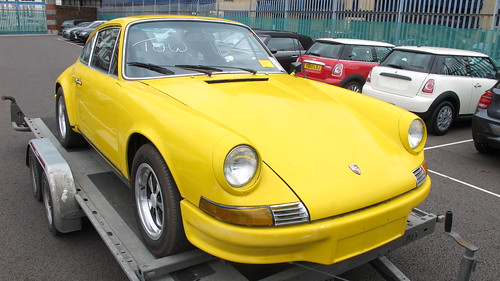
So several weeks later in early March I received an email letting me know the ship, complete with the car, had arrived, and a few days after that I was standing on a windswept quay looking at a tired old 911 and wondering what the hell I'd done.


Luckily there was a nice man there with a trailer ready to whisk it away.


Next: on the road again.

SS7