Monday, 22 October 2012

Skin


Why is it that many of today's cars, which bear almost no relation to those built at the dawn of motoring, still share one single component; a seat covered in dead animal skin?

Don’t get me wrong, dead animals have their place; its just that covering car seats isn’t one of them.

The stuff is freezing cold in the winter, likely to give you 1st degree burns on a hot day, and is slippery all the year around. It was originally selected because cars usually didn’t have roofs, and needed a tough seat covering that would stand up to the elements. When car builders eventually realised that a roof was a good thing, we all moved on. Take a look in the back seats (where the owners' bottoms rested) of an upmarket saloon from the 1920’s and you’ll find rich fabrics; the skin was reserved for the paid help up front who drove the owner around.


I appreciate that previous attempts to find a replacements for the stuff haven’t been all that successful; the 50s gave us vinyl, and the 60’s leatherette. Those efforts simply recreated the weak points of cow skin, and removed the one good point; the nice smell. A 70’s beige velour might not have been very much better, but at least you didn’t skid across it before hitting the (vinyl) door trim when trying to engage in what passed for enthusiastic cornering in those days.


My nearest branch of Millets is crammed with racks of warm, wind and weatherproof clothing made from high tech fabrics. The motor industry is capable of building vehicles with complex hybrid drivetrains, featherweight carbon chassis, and which pretty much drive themselves.  

Surely, a seat fabric that cools or heats as required, feels good to the touch, and grips you comfortably is not beyond their ability?

SS7

Friday, 19 October 2012

AC Cars and Porsche


I picked this snippet up from Trevor Legate's recent book on the Cobra.


In the late 50's, AC Cars were developing a replacement for the ancient 6 cylinder engine that had been used in AC's since 1919. Designed by their chief engineer Marczewski, it was conceived as (somewhat remarkably) an air cooled cylinder boxer that was to be built as a 4 and 6 cylinder.  A 6 cylinder version was fitted into a prototype Greyhound.

They had trouble, and Legate mentions "a visit to Porsche to discuss problems encountered with the smoothness of the engine.{which]...bought to light problems that could only be rectified by the design of an entirely new crankshaft. This was beyond Acs limited budget and the project faltered'.

AC then went in to use Bristol and Ford UK 6 cylinder engines until Carroll Shelby arrived on the scene. 

Its fascinating to think that AC could have had a air-cooled flat 6 engined sports car years before Porsche did.

SS7

Thursday, 18 October 2012

911T Project: Pedals


The final part of the ergonomics equation was the way the pedals were set up. My objectives were simple: a good brake feel, and an ability to heel and toe without uncomfortable contortions.

The pre-1974 911s are not fitted with a brake servo. While this leads to much greater pedal pressures it does remove one possible cause of a spongey pedal. As I had asked Tuthills to replace all of the flexible hoses, the system should be as good as it was going to be in standard form. Richard did try and talk me into their rally spec. braking system; its FIA approved and proven in countless Tuthill prepared cars. But at £1,000 a corner it was a big bill at this stage, especially as it looks as if the engine will be running in standard 140bhp form for some time longer. 

A key component of the Tuthills rally set up is an adjustable bias pedal box. Containing separate master cylinders for front and rear axles, this replaces the (possibly 40 years old...) original Porsche component with two moderns items, adds some nice braided hose, and would also let me adjust the pedal position a little as well. The front/rear balance is changed using a neat dash mounted knob. 

It seemed a good solution, so supply&fit was added to Tuthill's job list, along with some updated Ferodo pads for the 'S' spec callipers already on the car.


Porsche's standard accelerator pedal is frankly a bit cheap and nasty. I'm sure it's made of the finest German plastics, but after 40 years of use mine was looking shiny, slippery and worn. And in spite of the brake pedal changes, I was still finding it hard to comfortably use the side of my foot to give a rev-matching 'blip' on down changes. 

In one of the Porsche mags I spied the neat answer, an alloy pedal made by D-Zug in the US. Patterned on the one used by Porsche in the 917, not only did it give me the adjustability I neede, but was also set more towards the vertical, bringing it closer the the brake. It looked just was I was after. The D-Zug team were a delight to deal with, and within a couple of weeks a pedal in anodised dark alloy was delivered to SS7 Towers. 


It was beautifully made, simple to install, and the only slight hiccup caused by the unusual (for a European) imperial Allen key sizes used for the pivot I was able to sort using an old key I found at the back of my tool chest. 

The result is good pedal feel and perfect spacing for my size 10's. 

Oh, as an aside; I discovered sometime after placing my order with D-Zug that the well known Los Angeles based Porsche hot-rodder Magnus Walker uses their pedals in the fantastic cars he builds. 


Monday, 15 October 2012

911T Project: Seats and Wheel


It surprises me how often manufacturers get their driving positions so horribly wrong. That perfect arrangement of pedals, wheel and seat is surely not too difficult to nail, yet so often you end up compromising your reach to the wheel in order to get decent leg room, or sitting higher than you'd like, or generally just cramped and miserable.

I was determined to get this right in the 911, but to start I needed to sort out the best seats I could find. My list of requirements was straightforward; I was looking for a seat that gave decent support, allowed access to the rear of the car, looked reasonably at home in an older car and had runners (so that other people could use the car). 

Now the seat for a sports purpose 911 from the early 70's was made by Recaro. It is a low-back seat with good side bolsters and separate head rest/restraint, and usually covered with leatherette and a corduroy material. 


As an aside, the Recaro company sprung out of Reutter Carosserie, who built bodies for Porsche in the 50's. Known for their aftermarket sports and racing seats, Recaro still make most of the seats used in Porsches. 

Unfortunately the demand for these original early 70's sports seats has driven the price of good sets through the roof. There are a number of companies that make replicas, both in the US and in Europe, but I'll admit I had my reservations; would they be as comfortable as the real thing or would some slight difference in detail or proportion render the things unusable after a couple of hours? There was still the matter of cost, good replicas in vinyl with fittings cost the best part of £1,000 a side.

I also considered somehow adapting a later Porsche seat; removing the integral restraint and turning it into a low back with separate headrest.  The incredible Singer cars use something similar. The deep bolstered seats used in the early turbos and available as options on cooking cars looked a decent starting point:


Unfortunately at the time it proved difficult to find a specialist to do the work - although I have seen a set converted successfully since.


I started looking at the current Recaro range. While the fixed race-shell seats like the well known Pole Position would restrict access to the rear seats, the Sports seats might do the trick. But the barrier was again cost; a similar price to the better period replicas.

Then one evening I was surfing ebay and saw a set of Sportster CS seats listed in decent condition with a 'Buy It Now' price close to half that of new. I pulled the trigger. And the willing seller even had them delivered to Tuthills. Result.


They're not my first choice of colour(!) but I had some ideas to sort that in time. Because these seats are fitted from the base (unlike the shell seats) Tuthills had suitable runners on their shelves in a choice of heights. After a seat fitting it became clear I needed the lower of the two options.

The choice of steering wheel was much easier. Unless you want to use a rare Porsche Special Purpose wheel, or source an original 70's Momo like a Jackie Stewart, the Prototipo is the obvious answer.  I found one on ebay. 

However, my preference is for a slightly thicker rim, so I asked my trimmer, Joe at Trimdeluxe, to add another layer of black hide. As a little detail I had him use an off-white thread and added an ebay horn push.


 The result was excellent, and I delivered it to Tuthills when I was next visiting.

After a little experimentation with spacers, we finally had the desired result. I sit low in the car, and my leg is almost straight when the clutch is depressed. At the same time I don't have to stretch to the top of the wheel.

Here was the end result. The interior still had a long way to go, but at least I'm sitting comfortably!


Thursday, 11 October 2012

The Verdict


A week later I heard from Richard Tuthill.

I was really expecting a $25,000 phone call to tell me that the car was disastrously rusty/made out of three cars loosely welded together. 

To my great relief the good news was that the car was basically sound - certainly worth using as the basis for a decent road car. Tuthills had followed their usual practice; once the car was running it was taken down to the local MOT station for a once over. 

To no-one's surprise it didn't get a ticket first time around, but encouragingly the failures were minor, amounting to various non-functioning lights, and wear in the anti-roll bar mountings. Easily sorted.

The good news shared, Richard then let me have the downside. Like a lot of cars from the US, it needed a lot of work needed to bring the car up to a decent standard, and most of my budget was going to be consumed before we got to the exciting stuff. Even as he spoke I could feel my dreams of a hot engine disappearing into the far future. 

So this was the provisional job list:

- A full service, including work on the fuel system to try and resolve some running problems

- Fit UK specification headlights, indicator lights, and sort a functioning screen wash system

- Take out the vintage air-conditioning system, change the bodged single (and irredeemably knackered) battery for two correctly sized jobs located in the boxes either side of the luggage compartment, and tidy up the rat's nest of a loom

- Change the previous owner's approximate attempt to fit the front and rear fibreglass bumper's with a more permanent solution

- Undertake a full suspension refresh include new Bilstein Sport dampers, and a fast road specification torsion bar at the rear ( hollow 29mm affairs from Elephant Racing) and new bushes and ball joints as required

- Replace all the flexible brake hoses, pads and fit an adjustable bias pedal box

- Fit a Wevo external gated gear lever and linkage

- Replace the perished tyres with Continentals suitable for the 7" and 8" rims.

- Change perished side an rear window seals

Furthermore, it was clear that the interior would really benefit from new door cards, 3rd gear's synchromesh was long gone, and I needed to find some suitable seats and a steering wheel.

SS7

Tuesday, 9 October 2012

A Plan

While the car was on the boat I'd had plenty of time to figure out what sort of 911 I wanted to end up with. I wanted the focus to be on creating a car that was very usable on UK roads, with the emphasis on driving, not looks, one which took the lightweight, simple characteristics of the early 911s, and combined it with the best that 40-odd years of 911 development could provide. 

And I didn't have a huge budget.

I was looking for a specialist and technical partner that understood what I was trying to achieve. There are a number of specialists in the UK who have good reputations for building competition cars and road-going hot-rod 911s.  That was important, I didn't want to be responsible for expensive prototyping, and would far rather benefit from proven solutions using good quality components. I also felt that working with a reputable specialist wouldn't hurt with the re-sale - if it ever came to it.

After meeting several and exchanging emails, I decided to ask Tuthill's in Banbury to take on the task. As well as being responsible for what seemed like every historic rally winning 911 for the last decade, Richard Tuthill really seemed to 'get' what I was aiming for. 

Here's the email I sent him:

"I'm not into massive speed, so don't really exceed three figures on the open road, yet want to be able to cruise quietly through the 30/40's.  I don't want a stripped out road-racer either, so will want to retain sound deadening and fit some sort of sound system.


I like the S/T look, but with a bit of a rat-look spin. A superb paint job and leather/alcantara interior would be lovely, but I don't have the budget for a full restoration. I'll keep the yellow matt paint for now, and might do a quick job with a black rattle can on the boot and bonnet.

So my objectives for a hotrod project are:

- safety; it'll need seatbelts, and ensuring that the fuel, wiring, lighting and brake systems etc. are serviceable

- reliability and efficiency; 25mpg is going to be a lot more acceptable than 15!
                
- suspension that combines compliance, handling balance with excellent body-control
                
 - steering that gives feel and feedback without kickback
                
 - usable rear seats (with belts)

 - resilience; I want to be able to use it in the wet, so door/window/roof seals etc. should be fresh, and it might need some protection underneath.

- brakes with good feel and a solid pedal set up for heel & toing
                 
- great driving position; I like to sit low with the wheel reasonably close. In my Cayman the seat was as low as it would go, a couple o notches back from the max, and with the steering column as extended as it would go and set quite high.
               
 - Seats & steering wheel; I'd like a 'low-back' period-style seat with head restraint, it needs to be supportive but I much prefer fabric upholstery. I had big Recaros in my 968ClubSport; loved the position (once I'd taken the cushion out) and support, but getting in and out was a pain. I need rear access via at least the passenger side. So far I've not seen a lot that works better in an old 911 than a Momo Prototipo, even if it is a bit of a cliche. The car's current seats and wheel are horrible!

- Good gearchange. I've some experience of the 915 'box, mostly bad! I'd like at least to have confidence that I'm going to get the gear that I want. The best 'change I've experienced was in a Honda S2000, but my Caterham's 4 speed rocket was up there.

- Decent performance; I reckon 225 - 250bhp is going to be all I need, especially in a 1100kg car. I want an engine that has low inertia, is responsive, performs without fuss at low speed but has a 4500rpm kick. I don't need an 8000rpm screamer. It also has to be able to deal with everyday use, not need attention every few thousand miles and be reasonable economical. 

So within a couple of hours of me taking possession, the car was on its way to Banbury for an appointment with Tuthill's technicians.

Meanwhile, I spent the next few days on the phone waiting for the bad news.

SS7


Tuesday, 25 September 2012

Arrival Southampton

Continuing the story of my Florida souvenir.

Once I'd negotiated a price on the yellow 911T and arrange to transfer funds to the dealer, the next stage was retrieving it from Florida and getting it to West Sussex. I assumed this was a process full of pitfalls, and that I'd end up bruised, helpless and penniless in the face of overwhelming customs bureaucracy.  In fact, I almost resigned myself to face the probability that car and money would disappear into a mid-atlantic hole and all I'd be left with was a good story.

Actually nothing could be further from the truth, importing the car was more or less completely painless. A shipping company had been recommended to me by a number of sources, so I gave them a phone call. And that's pretty much all I did do, once Allan at Kingstown Shipping had the car's details and some paperwork,  he arranged everything; the collection of the car from New Smyrna Beach, transport to a port, loading onto a ship and then delivery to Southampton.

He even sorted out the customs paperwork, and was able to take advantage of a ruling that allows 'historic' vehicles to be imported on a lover rate of VAT; 5%.  A rare thing that; an old Porsche bill that's smaller than you expect....

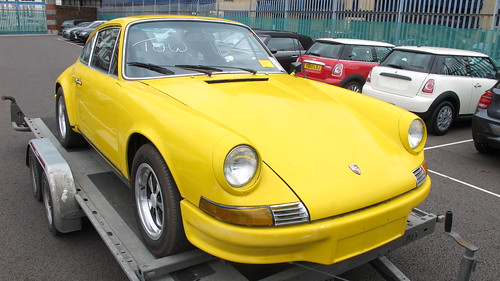
So several weeks later in early March I received an email letting me know the ship, complete with the car, had arrived, and a few days after that I was standing on a windswept quay looking at a tired old 911 and wondering what the hell I'd done.


Luckily there was a nice man there with a trailer ready to whisk it away.


Next: on the road again.

SS7